
While there is much controversy surrounding the composition of textiles used by the fashion industry, we are being completely transparent in explaining how we choose them ourselves.
At Cotélac, everything most often starts with the raw material. "During specialized trade fairs, we go looking for yarns or fabrics that we select for their visual appearance, their hand, and their technical properties," explains Janelle Cox, assistant at the design office. "Then, we have samples sent to us and, based on these, we imagine the pieces we will be able to create with this or that fiber."
"It’s a way of working that I had never experienced before working at Cotélac," explains Céline Wolf, assistant designer. "It is true that our way of proceeding may seem different from that of other brands," adds Nathalie Carrera, a designer at the design office. "This stems from Raphaëlle's* working method. Trained at the Beaux-Arts, she has always prioritized materials. Of course, before selecting them, we carry out preliminary research and have a rough idea of what we want to do. But they always inspire us enormously."
*Raphaëlle Cavalli, Creative Director of Cotélac
The points that make the difference: the treatment of the base yarn, the manufacturer's expertise, the dyeing processes, the final finish (washed, textured, or even crumpled…). "Depending on the country, the quality and the finishes are not at all the same," clarifies Janelle. "Even for artificial fibers, there are significant differences. Those produced in Korea and Japan, for example, have a much more natural hand." These artificial fibers, which are technically essential for transforming the material into tight pleats or gathered effects, are therefore not all equivalent.
More and more organic and sustainable materials
"We cannot just say: let's stop importing fabrics from Asia! Of course, we always try to make our purchases as close to home as possible. But sometimes it is impossible to find certain equivalent textiles outside of countries where the expertise is unique!" And regardless of the origin, textile blends that contain the fewest possible synthetic fibers are favored. "We make sure to meet high technical constraints while keeping this concern in mind."
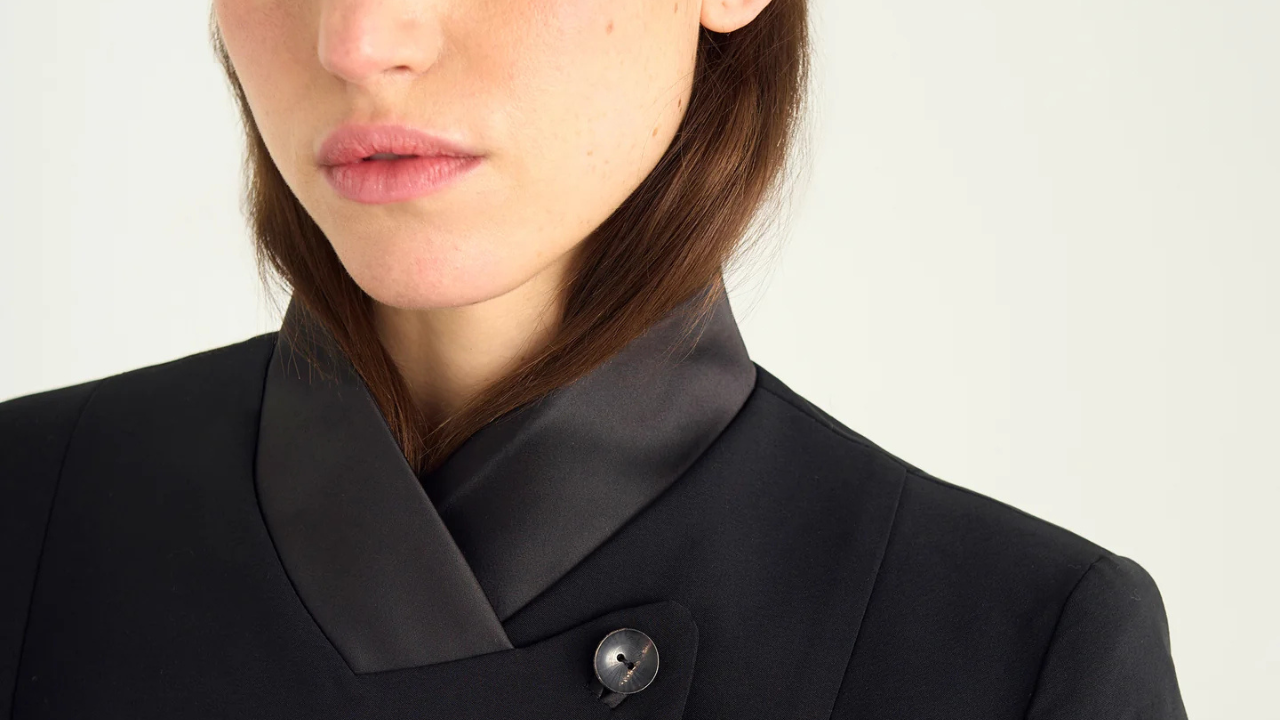
"No plastic for buttons, for example," explains Céline Wolf, assistant designer. "We use mother-of-pearl from Corozo pearl oyster farms. Less well-known, the latter, also called vegetable ivory, comes from a fruit from ivory palms that grow naturally in tropical forests." "It is very resistant and holds color well: it is much prettier and ages much better than plastic!"
Generally speaking, it is easier today to find organic and sustainable fibers. "I remember that for a long time, they were rare and presented really separately at trade fairs. They seemed a bit inaccessible," recalls Nathalie. "They are more common today, and that’s a good thing!" They are therefore increasingly integrated into collections, including for synthetic materials, with the development of textiles derived from recycling.
"We try to be as vigilant as possible, but it’s not always simple," specifies Nathalie. "Indeed, in this field too, there can be surprises. I remember hearing about a polyester manufacturer that produced its own plastic bottles just so it could market a supposedly 'recycled' textile: a total aberration!"
Bamboo, paper, kapok…
In fact, in the collections, we find very varied and sometimes surprising compositions: paper - appreciated for its dry, fresh appearance and its unique hand - bamboo, the cultivation of which requires four times less water than cotton - kapok (a silky and light vegetable fiber) … Others are more common on clothing composition labels but not necessarily better known. Such as viscose, for example: wood or bamboo fibers that are very practical for providing softness and fluidity…
"But in this area too, there are different brands with their own recipes and products of varying quality," emphasizes Nathalie. "For our part, when it comes to viscose, we like working with Cupro." This yarn, which looks a bit like silk but is slightly heavier, is a cellulose fiber whose manufacturing process is environmentally friendly.
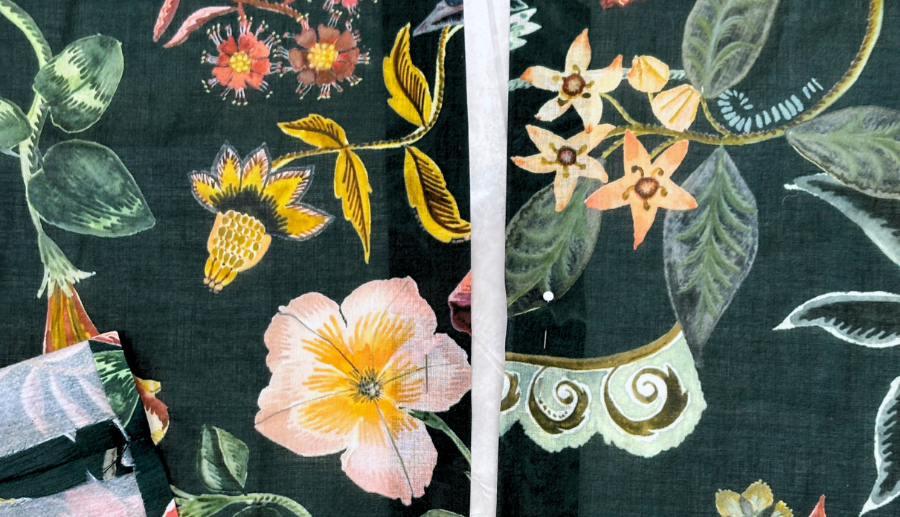
The printing method also makes a difference. "We do everything we can to ensure quality right to the end," specifies Janelle. "Depending on technical constraints, the most suitable processes are selected. For a design with a multitude of colors, the inkjet process is the most relevant. For prints that will subsequently be reworked, pleated, or gathered, the choice will fall on sublimation, a technique with infinite creative possibilities and whose patterns are indelible over time." To fix the colors, sublimation requires a fabric that is more than 50% synthetic fiber, but it allows for unparalleled customization. "Finally, when it is technically possible, we favor traditional printing," explains Janelle. "This requires having engraved rollers for each of the colors. It is therefore not suitable for all prints." But in terms of quality - as with sublimation - it allows for patterns that will not fade over time because the fibers are completely impregnated with the colors.
For fifteen years, to print these materials using traditional methods, Cotélac has chosen to favor French workshops with the desire to keep them operating and to preserve expertise in France. This is the case, for example, with the Ateliers d'ennoblissement textile de La Turdine located in Tarare, near Lyon, or a workshop located in Saint-Savin in Isère, specializing in cylinder engraving for textile printing. Partners who, like Cotélac, have managed to preserve their traditional methods and their production sites in France.